
HQ Tel. +49(0)89-235-16-801
US Tel. +1 765-780-7139
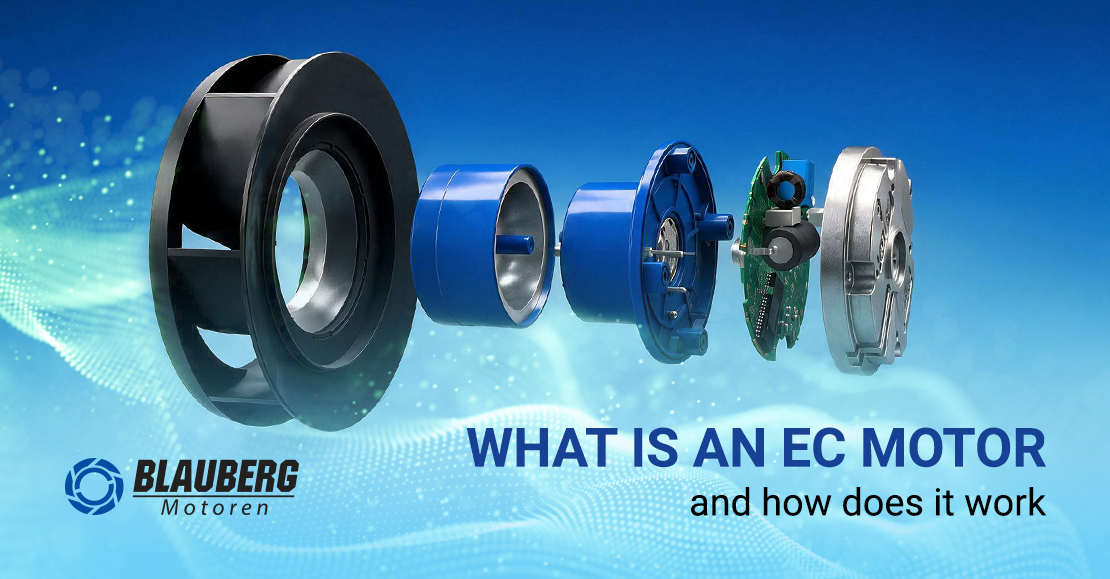
An EC motor is an electronically commutated motor - that is, a permanent-magnet synchronous motor whose operation is controlled by embedded electronics. It is these electronics that make the EC motor the foundation of energy-efficient ventilation.
An EC fan can operate on either an alternating current (AC) or a direct current (DC) power source. If AC is applied to the input, the control board first converts it to DC and then generates AC with the required frequency, which is set by the electronics itself. As a result, the speed is not tied to the mains frequency, and the motor operates just as stably at both 50 Hz and 60 Hz.
Structurally, an EC motor consists of three main components:
The operating principle can be described as follows:
Since the switching timing is controlled by electronics rather than the mains frequency, the speed can be adjusted precisely and smoothly with no need for an external frequency converter. EC motors offer significant advantages over AC (asynchronous motors): lower energy consumption and higher efficiency, less heat generation, and built-in speed control.
Why EC fans are now a market necessity rather than a mere whim – this is a topic for a separate article, which you’ll be able to read in our upcoming publications.